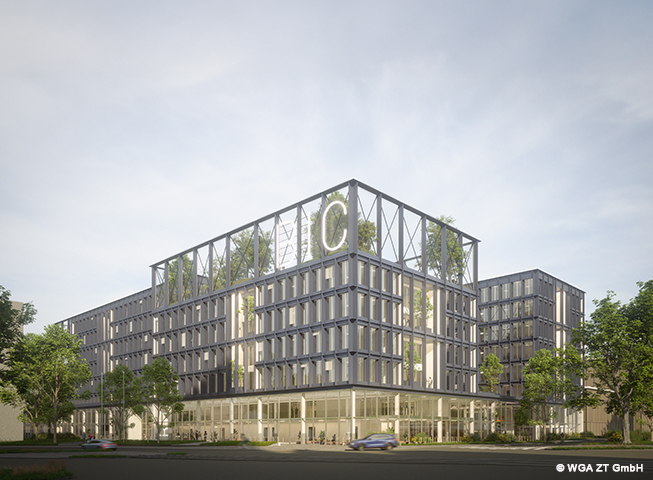
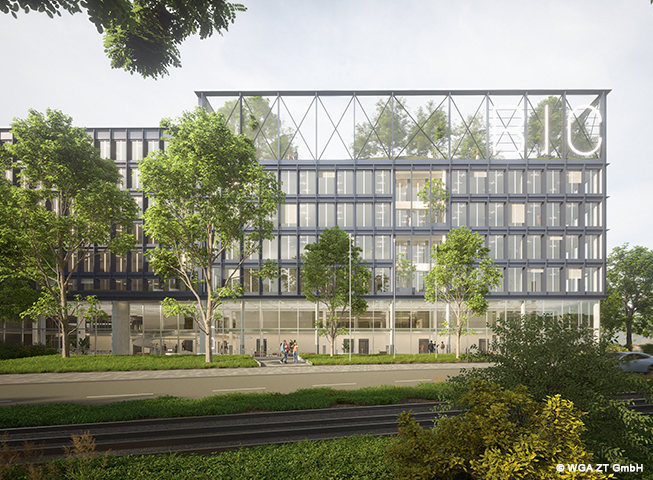
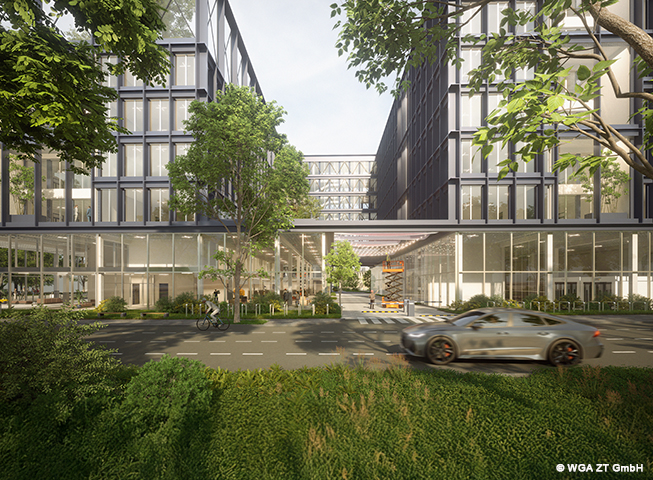
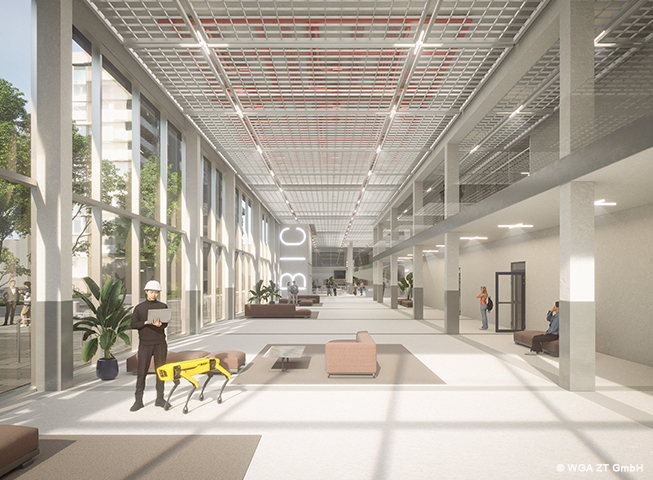
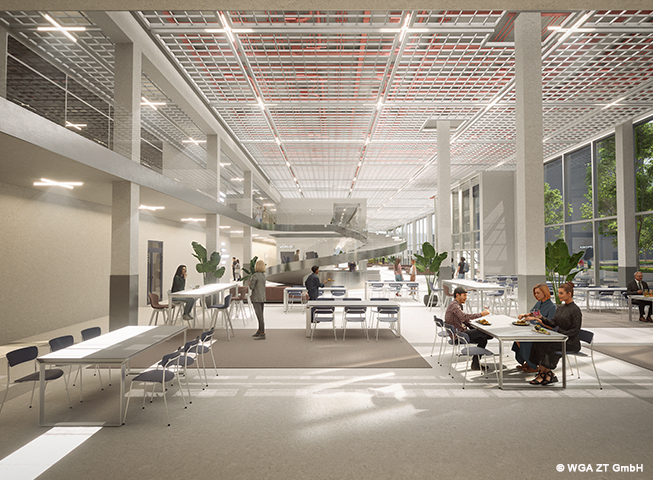
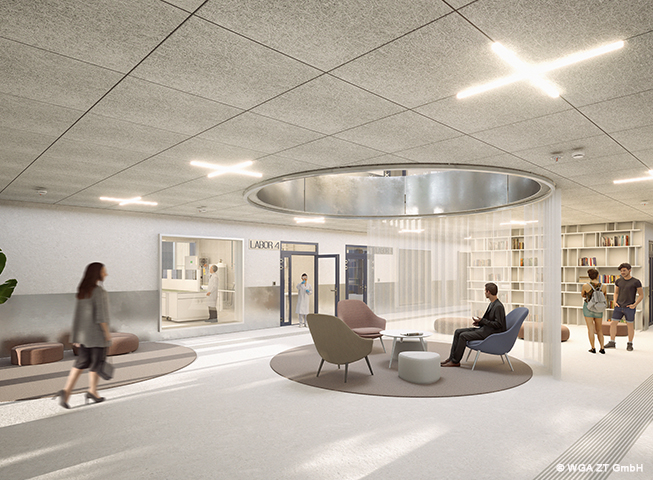
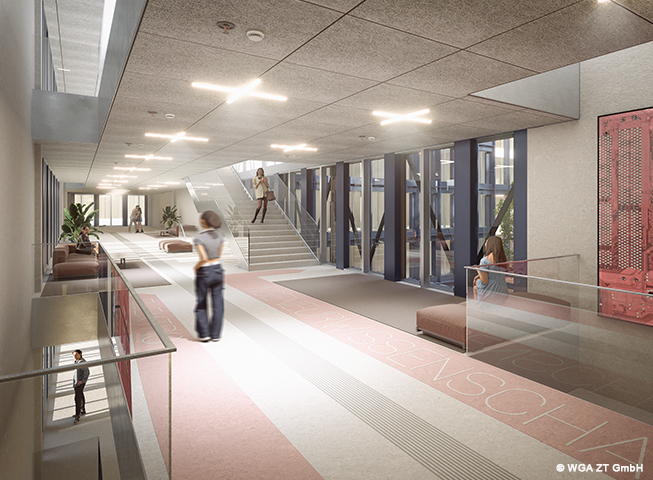
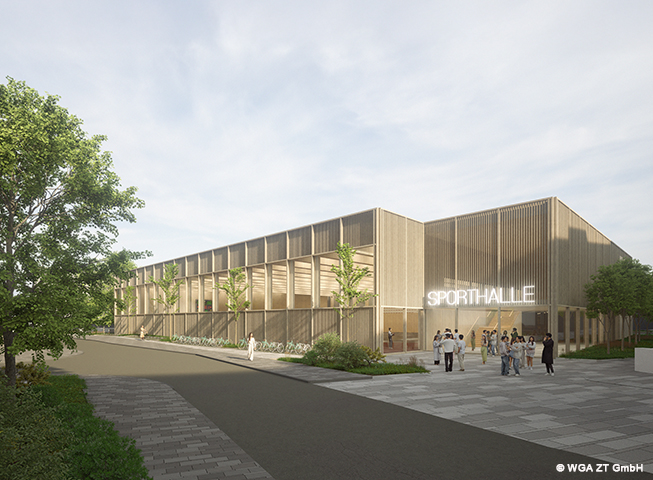
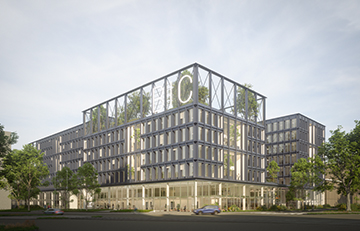
This accessible, sustainable Education and Innovation Campus, a pioneering large-scale project in Gelsenkirchen’s urban development, makes a strong, landmark statement at a central transport junction. Within the urban context, the new building integrates into the existing cultural and leisure landscape comprising the music theatre, the central swimming pool and the music school, bringing these institutions together to form a cohesive urban ensemble. The building is constructed as a column-and-beam structure using prefabricated timber and reinforced concrete elements, and is characterised by a transparent, two-storey plinth that functions as an open ‘anchor storey’. The extensive glazing opens up the building, allowing the workshops, laboratories and communal areas housed within to be visually experienced and conveying its innovative, technical character directly to the outside world. Rising above this communicative plinth are three compact, staggered volumes housing specialist and synergy areas. The rational façade structure is based on prefabricated timber panel elements with robust aluminium cladding. Vertical and horizontal aluminium structural elements create a three-dimensional sense of depth, whilst a graduated blue hue across the three building volumes, together with accentuated recesses and loggias, lend the overall composition a distinctive visual identity. Access to the interior is intuitive and barrier-free via the impressive, two-storey main foyer on Florastraße, which leads to the canteen, seminar centre and a through-to-the-other-side workshop yard. The workshop areas (automotive, electrical, construction, metalwork), which can be flexibly partitioned, are directly connected to the workshop yard via façades that can be opened up to a large extent. On the upper floors, the classrooms and laboratories are arranged along the naturally lit external walls, whilst the circulation cores, ancillary rooms and open learning zones occupy the central communal area. A striking bridge structure connects the three building blocks and serves as a spacious lounge and break area spanning multiple storeys. Open spaces, flexible sightlines and integrated curtains and sliding walls allow for a quick transition between transparent areas designed to foster synergy and low-stimulus retreat areas. The modular structure also ensures that individual units, such as the seminar area or the canteen, can be used independently outside regular school hours. The open-space concept consistently follows the guiding principle of a climate-adapted ‘sponge city’. The use of rainwater for irrigation further reduces fresh water consumption.
Education and Innovation Campus Gelsenkirchen – Our competition entry at the Hans-Sachs-Haus
Until 8 July 2026, anyone interested can visit the exhibition on the competition ‘2nd Architectural Competition for the Education and Innovation Campus – New Building for the Vocational College for Technology and Design’ at the Hans-Sachs-Haus in Gelsenkirchen. One of … Continued